Comparative responses of contrasting monsoon rice varieties to zinc feeding approaches under rainfed conditions
DOI:
https://doi.org/10.14719/tcb.9469Keywords:
foliar spray, root dipping, soil application, zinc fertilization, zinc-use efficiencyAbstract
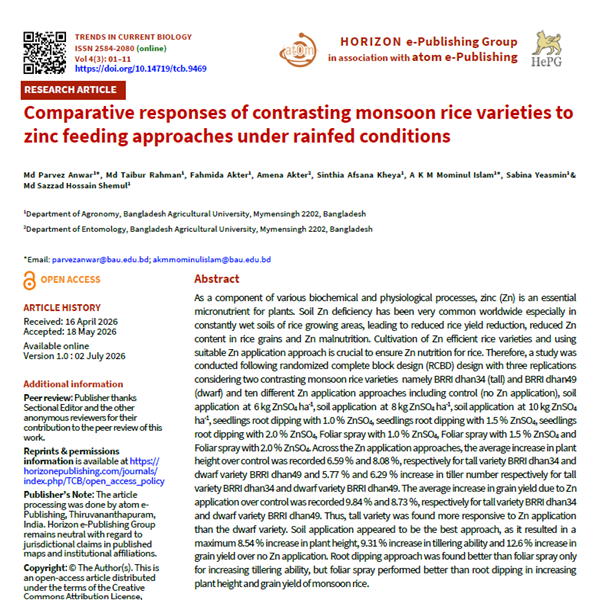
As a component of various biochemical and physiological processes, zinc (Zn) is an essential micronutrient for plants. Soil Zn deficiency has been very common worldwide especially in constantly wet soils of rice growing areas, leading to reduced rice yield reduction, reduced Zn content in rice grains and Zn malnutrition. Cultivation of Zn efficient rice varieties and using suitable Zn application approach is crucial to ensure Zn nutrition for rice. Therefore, a study was conducted following randomized complete block design (RCBD) design with three replications considering two contrasting monsoon rice varieties namely BRRI dhan34 (tall) and BRRI dhan49 (dwarf) and ten different Zn application approaches including control (no Zn application), soil application at 6 kg ZnSO4 ha-1, soil application at 8 kg ZnSO4 ha-1, soil application at 10 kg ZnSO4 ha-1, seedlings root dipping with 1.0 % ZnSO4, seedlings root dipping with 1.5 % ZnSO4, seedlings root dipping with 2.0 % ZnSO4, Foliar spray with 1.0 % ZnSO4, Foliar spray with 1.5 % ZnSO4 and Foliar spray with 2.0 % ZnSO4. Across the Zn application approaches, the average increase in plant height over control was recorded 6.59 % and 8.08 %, respectively for tall variety BRRI dhan34 and dwarf variety BRRI dhan49 and 5.77 % and 6.29 % increase in tiller number respectively for tall variety BRRI dhan34 and dwarf variety BRRI dhan49. The average increase in grain yield due to Zn application over control was recorded 9.84 % and 8.73 %, respectively for tall variety BRRI dhan34 and dwarf variety BRRI dhan49. Thus, tall variety was found more responsive to Zn application than the dwarf variety. Soil application appeared to be the best approach, as it resulted in a maximum 8.54 % increase in plant height, 9.31 % increase in tillering ability and 12.6 % increase in grain yield over no Zn application. Root dipping approach was found better than foliar spray only for increasing tillering ability, but foliar spray performed better than root dipping in increasing plant height and grain yield of monsoon rice.
Downloads
References
Ahmad W, Watts MJ, Imtiaz M, Ahmed I, Zia MH. Zinc deficiency in soils, crops and humans. Agrochimica. 2012;56(2):65-97.
Kumara KHCH, Hafeel RF, Mirihagalla MKPN, Wathugala DL. Effect of different methods of application of Zn with reduced NPK fertilizer levels on growth, yield and grain quality of transplant rice (Oryza sativa L.) var. AT 362. Trop Agric Res Ext. 2021;24(2):85-92. https://doi.org/10.4038/tare.v24i2.5528
Alloway BJ. Zinc in soils and crop nutrition. 2nd ed. Brussels: International Zinc Association; Paris: International Fertilizer Industry Association; 2008.
Fageria NK, Baligar VC, Clark RB. Micronutrients in crop production. Adv Agron. 2002;77:185-268. https://doi.org/10.1016/S0065-2113(02)77015-6
Johnson-Beebout SE, Lauren JG, Duxbury JM. Immobilization of zinc fertilizer in flooded soils monitored by adapted DTPA soil test. Commun Soil Sci Plant Anal. 2009;40(11-12):1842-61. https://doi.org/10.1080/00103620902896738
Jahiruddin M. Biofortification of food crops: a novel strategy for reducing micronutrient malnutrition. Fundam Appl Agric. 2020;5(2):133-46.https://doi.org/10.5455/faa.96078
Wessells KR, Singh GM, Brown KH. Estimating the global prevalence of inadequate zinc intake from national food balance sheets: effects of methodological assumptions. PLoS One. 2012;7(11):e50565. https://doi.org/10.1371/journal.pone.0050565
Cakmak I. Enrichment of cereal grains with zinc: agronomic or genetic biofortification? Plant Soil. 2008;302(1-2):1-17. https://doi.org/10.1007/s11104-007-9466-3
Jan M, Anwar-ul-Haq M, Akhtar J, Waraich EA. Genotypic variation in zinc response of salt-stressed rice (Oryza sativa L.) plants in hydroponics. Pak J Agric Sci. 2015;52(1):135-44.
Mazhar Z, Akhtar J, Qureshi RH, Ahmad R. Varietal difference in Zn responsiveness of rice under normal and saline conditions. Pak J Bot. 2023;55(3):825-36.
Dotaniya ML, Meena VD. Rhizosphere effect on nutrient availability in soil and its uptake by plants: a review. Proc Natl Acad Sci India Sect B Biol Sci. 2015;85(1):1-12. https://doi.org/10.1007/s40011-013-0297-0
Jha S, Anwar MP, Rashid MH, Paul SK. Maximizing yield of mustard through zinc and boron fertilization. Fundam Appl Agric. 2023;8(1-2):435-42. https://doi.org/10.5455/faa.156450
Tanjim F, Anwar MP, Yeasmin S, Amran AH, Faria JH, Priya NN, et al. Yield enhancement of hybrid boro rice through zinc, boron and triacontanol application. Rev Food Agric. 2024;5(1):61-68. https://doi.org/10.26480/rfna.01.2024.61.68
Karim MR, Zhang Y, Zhao R, Chen X, Zhang F, Zou C. Alleviation of drought stress in winter wheat by late foliar application of zinc, boron, and manganese. J Plant Nutr Soil Sci. 2012;175(1):142-51.https://doi.org/10.1002/jpln.201100141
Khan M, Fuller MP, Baloch FS. Effect of soil-applied zinc sulphate on wheat (Triticum aestivum L.) grown on a calcareous soil in Pakistan. Cereal Res Commun. 2008;36(4):571-82. https://doi.org/10.1556/CRC.36.2008.4.6
Afrin S, Anwar MP, Rahman MM, Hasan AK, Forhad FA, Yeasmin S, et al. Comparative performance and economics of different zinc application approaches in boro rice. Fundam Appl Agric. 2022;7(2):121-30.https://doi.org/10.5455/faa.87165
Fageria NK, dos Santos AB, Cobucci T. Zinc nutrition of lowland rice. Commun Soil Sci Plant Anal. 2011;42(14):1719-27. https://doi.org/10.1080/00103624.2011.584591
Slaton NA, Wilson CE Jr, Ntamatungiro S, Norman RJ, Boothe DL. Evaluation of zinc seed treatments for rice. Agron J. 2001;93(1):152-57.https://doi.org/10.2134/agronj2001.931152x
Yuan L, Wu L, Yang C, Lv Q. Effects of iron and zinc foliar applications on rice plants and their grain accumulation and grain nutritional quality. J Sci Food Agric. 2013;93(2):254-61. https://doi.org/10.1002/jsfa.5749
Mustafa G, Ehsanullah, Akbar N, Qaisrani SA, Iqbal A, Khan H, et al. Effect of zinc application on growth and yield of rice (Oryza sativa L.). Int J Agro Vet Med Sci. 2011;5(6):530-35. https://doi.org/10.5455/ijavms.9383
Khan MU, Qasim M, Subhan M, Jamil M, Riazuddin DA. Response of rice to different methods of zinc application in calcareous soil. J Appl Sci. 2003;3(7):524-29. https://doi.org/10.3923/jas.2003.524.529
Rehman H, Aziz T, Farooq M, Wakeel A, Rengel Z. Zinc nutrition in rice production systems: a review. Plant Soil. 2012;361(1-2):203-26. https://doi.org/10.1007/s11104-012-1346-9
Bangladesh Agricultural Research Council. Fertilizer Recommendation Guide 2024. Dhaka: Bangladesh Agricultural Research Council; 2024. p. 215.
Akondo MRI, Hossain MB, Akter SE, Islam MM. Growth and yield performance of BINA released six promising aman rice varieties of Bangladesh. Asian Plant Res J. 2020;6(3):18-25. https://doi.org/10.9734/aprj/2020/v6i330130
Chakrobarty T, Al Galib MA, Islam MZ, Rahman MA. Adoption and adaptability of modern aman rice cultivars in Faridpur region, Bangladesh. SABRAO J Breed Genet. 2021;53(4):659-72. https://doi.org/10.54910/sabrao2021.53.4.9
Khatun S, Mondal MMA, Khalil MI, Roknuzzaman M, Mollah MMI. Growth and yield performance of six aman rice varieties of Bangladesh. Asian Res J Agric. 2020;12(2):1-7. https://doi.org/10.9734/arja/2020/v12i230077
Impa SM, Morete MJ, Ismail AM, Schulin R, Johnson-Beebout SE. Zn uptake, translocation and grain Zn loading in rice (Oryza sativa L.) genotypes selected for Zn deficiency tolerance and high grain Zn. J Exp Bot. 2013;64(10):2739-51. https://doi.org/10.1093/jxb/ert118
Sarwar N, Ali H, Ahmad A, Ullah E, Ahmad S, Mubeen K, et al. Water-wise rice cultivation on calcareous soil with the addition of essential micronutrients. J Anim Plant Sci. 2013;23(1):244-50.
Kandil EE, El-Banna AAA, Tabl DMM, Mackled MI, Ghareeb RY, Al-Huqail AA, et al. Zinc nutrition responses to agronomic and yield traits, kernel quality, and pollen viability in rice (Oryza sativa L.). Front Plant Sci. 2022;13:791066. https://doi.org/10.3389/fpls.2022.791066
Hafeez B, Khanif YM, Saleem M. Role of zinc in plant nutrition: a review. Am J Exp Agric. 2013;3(2):374-91. https://doi.org/10.9734/AJEA/2013/2746
Lefèvre I, Vogel-Mikuš K, Jeromel L, Vavpeti? P, Planchon S, Ar?on I, et al. Differential cadmium and zinc distribution in relation to their physiological impact in the leaves of the accumulating Zygophyllum fabago L. Plant Cell Environ. 2014;37(6):1299-320. https://doi.org/10.1111/pce.12234
Yoshida S, McLean GW, Shafi M, Mueller KE. Effects of different methods of zinc application on growth and yields of rice in a calcareous soil, West Pakistan. Soil Sci Plant Nutr. 1970;16(4):147-49. https://doi.org/10.1080/00380768.1970.10432832
Guo JX, Feng XM, Hu XY, Tian GL, Ling N, Wang JH, et al. Effects of soil zinc availability, nitrogen fertilizer rate and zinc fertilizer application method on zinc biofortification of rice. J Agric Sci. 2016;154(4):584-97. https://doi.org/10.1017/S0021859615000441
Degryse F, Baird R, McLaughlin MJ. Diffusion and solubility control of fertilizer-applied zinc: chemical assessment and visualization. Plant Soil. 2015;386(1-2):195-204. https://doi.org/10.1007/s11104-014-2266-7
Jalal A, Júnior EF, Teixeira Filho MCM. Interaction of zinc mineral nutrition and plant growth-promoting bacteria in tropical agricultural systems: a review. Plants. 2024;13(5):571. https://doi.org/10.3390/plants13050571
Leite CMDC, Muraoka T, Colzato M, Alleoni LRF. Soil-applied Zn effect on soil fractions. Sci Agric. 2020;77(2):e20180124. https://doi.org/10.1590/1678-992x-2018-0124
Saikh R, Murmu K, Sarkar A, Mondal R, Jana K. Effect of foliar zinc application on growth and yield of rice (Oryza sativa) in the Indo-Gangetic Plains of India. Nusant Biosci. 2022;14(2):182-87. https://doi.org/10.13057/nusbiosci/n140208
Zhao A, Tian X, Cao Y, Lu X, Liu T. Comparison of soil and foliar zinc application for enhancing grain zinc content of wheat when grown on potentially zinc-deficient calcareous soils. J Sci Food Agric. 2014;94(10):2016-22. https://doi.org/10.1002/jsfa.6518
Downloads
Published
Issue
Section
License
Copyright (c) 2026 Md Parvez Anwar, Md Taibur Rahman, Fahmida Akter, Amena Akter, Sinthia Afsana Kheya, A K M Mominul Islam, Sabina Yeasmin, Md Sazzad Hossain Shemul

This work is licensed under a Creative Commons Attribution 4.0 International License.