Structure-based computational analysis of jamun (Syzygium cumini) seed phytochemicals targeting the type 2 diabetes-associated human dipeptidyl peptidase 4 (DPP4) protein
DOI:
https://doi.org/10.14719/tcb.9437Keywords:
diabetes mellitus, DPP4, jamun, molecular docking, phytochemicalsAbstract
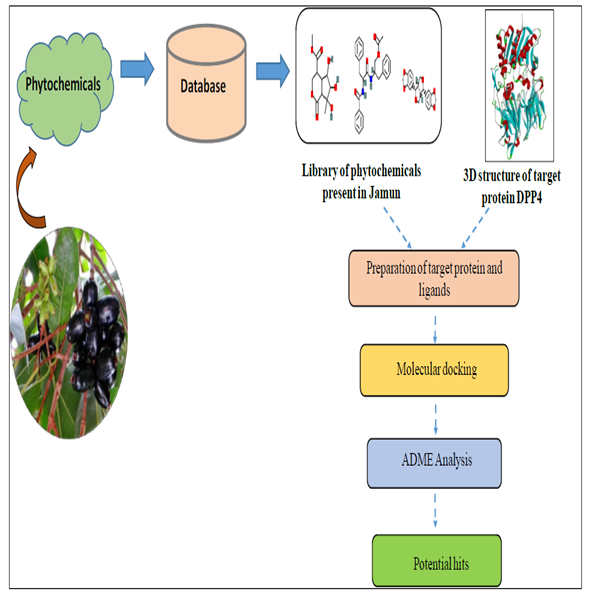
Type 2 Diabetes Mellitus (T2DM) is a metabolic chronic illness that imposes a health challenge, worldwide. Although there are conventional antidiabetic drugs available, there are still increasing demands of safer and cheaper drugs. Syzygium cumini (jamun) is a traditional medicinal plant that contains numerous bioactive phytochemicals that can be utilised towards diabetes control in terms of therapeutic potential. In silico drug discovery method was adopted in this work to screen some of the phytochemicals in S. cumini seeds against the target protein dipeptidyl peptidase 4 (DPP4), which is suspected to regulate glucose metabolism. The binding affinities and interaction patterns were determined by molecular docking and the ADMET (Absorption, Distribution, Metabolism, Excretion and Toxicity) of compounds was analyzed to determine pharmacokinetics and safety profile of the compounds. The binding affinities of three compounds quercetin, ellagic acid and ?-sitosterol were found in a good range and the ADMET profile of these compounds was suggesting that these compounds may be used as potential hits to anti-diabetic drug discovery. In vitro and in vivo studies are needed to confirm these findings further.
Downloads
References
Deacon CF. Physiology and pharmacology of DPP-4 in glucose homeostasis and the treatment of type 2 diabetes. Front Endocrinol. 2019;10:80. https://doi.org/10.3389/fendo.2019.00080
Makrilakis K. The role of DPP-4 inhibitors in the treatment algorithm of type 2 diabetes mellitus: when to select, what to expect. Int J Environ Res Public Health. 2019;16(15):2720. https://doi.org/10.3390/ijerph16152720
Garg P, Duggal N. Type 2 diabetes mellitus, its impact on quality of life and how the disease can be managed-a review. Obes Med. 2022;35:100459. https://doi.org/10.1016/j.obmed.2022.100459
Nistala R, Savin V. Diabetes, hypertension and chronic kidney disease progression: role of DPP4. Am J Physiol Renal Physiol. 2017;312:F661-F70. https://doi.org/10.1152/ajprenal.00316.2016
Lee S, Lee H, Kim Y, Kim E. Effect of DPP-IV inhibitors on glycemic variability in patients with T2DM: a systematic review and meta-analysis. Sci Rep. 2019;9(1):13296. https://doi.org/10.1038/s41598-019-49803-9
Bayanati M, Ismail Mahboubi Rabbani M, Sirous Kabiri S, Mir B, Rezaee E, Tabatabai SA. Dipeptidyl peptidase-4 inhibitors: a systematic review of structure-activity relationship studies. Iran J Pharm Res. 2024;23(1):e151581. https://doi.org/10.5812/ijpr-151581
Duez H, Cariou B, Staels B. DPP-4 inhibitors in the treatment of type 2 diabetes. Biochem Pharmacol. 2012;83(7):823-32. https://doi.org/10.1016/j.bcp.2011.11.028
Kaur S, Chaudhary R. A comprehensive review of the effects of Psidium guajava and Syzygium cumini leaves on diabetes mellitus. Prev Nutr Food Sci. 2025;30(3):209-21. https://doi.org/10.3746/pnf.2025.30.3.209
Kumar S, Sharma S, Kumar V, Sharma A, Kaur R, Saini R. Jamun (Syzygium cumini (L.) Skeels): the conventional underutilized multifunctional plant-a view into its food and functional significance. Ind Crops Prod. 2023;191:115873. https://doi.org/10.1016/j.indcrop.2022.115873
Hidayah H, Suherti I, Azzahra SS. Java Plum (Syzygium cumini (L.)) seeds potentials in medicinal uses: a systematic literature review. Eureka Herba Indonesia. 2023;4(2):221-6. https://doi.org/10.37275/ehi.v4i2.72
Swami SB, Thakor NS, Patil MM, Haldankar PM. Jamun (Syzygium cumini (L.)): a review of its food and medicinal uses. Food Nutr Sci. 2012;3(8):1100-17. https://doi.org/10.4236/fns.2012.38146
Chhikara N, Kaur R, Jaglan S, Sharma P, Gat Y, Panghal A. Bioactive compounds and pharmacological and food applications of Syzygium cumini - a review. Food Funct. 2018;9(12):6096-115. https://doi.org/10.1039/C8FO00654G
Ahirwar R, Kumar S, Paradkar S, Singh S, Raghuwanshi S, Yadav S, et al. Phytochemical screening of jamun seed (Syzygium cumini). Int J Sci Res Technol; 2025.
Das G, Nath R, Das Talukdar A, Sharma P, Kumar V, Singh R, et al. Major bioactive compounds from Java plum seeds: an investigation of its extraction procedures and clinical effects. Plants (Basel). 2023;12(6):1214.
Jagetia GC. Phytochemical composition and pleiotropic pharmacological properties of jamun, Syzygium cumini Skeels. J Explor Res Pharmacol. 2017;2(2):54-66. https://doi.org/10.14218/JERP.2016.00038
Kaur D, Yousuf B, Qadri OS. Syzygium cumini anthocyanins: recent advances in biological activities, extraction, stability, characterisation and utilisation in food systems. Food Prod Process Nutr. 2024;6(1):34. https://doi.org/10.1186/s43014-023-00177-6
Panigrahi GK, Sahoo SK, Sahoo A, Behera S, Sahu SR, Dash A, et al. Bioactive molecules from plants: a prospective approach to combat SARS-CoV-2. Adv Tradit Med. 2023:1-14.
Majumder S, Panigrahi GK. Molecular docking and ADME evaluation of plant-based bioactive molecules targeting nonsense-mediated mRNA decay pathway factors to modulate tumorigenesis. Plant Sci Today. 2024. https://doi.org/10.14719/pst.3737
Pardo CG, Paranada JAR. Exploring the medicinal plants and traditional knowledge for common respiratory ailments among farmers in Ilocos Sur, Philippines. Plant Sci Today. 2025;12(3). https://doi.org/10.14719/pst.7332
George BP, Chandran R, Abrahamse H. Role of phytochemicals in cancer chemoprevention: insights. Antioxidants. 2021;10:1455. https://doi.org/10.3390/antiox10091455
Majrashi TA, Alshehri SA, Alsayari A, Muhsinah AB, Alrouji M, Alshahrani AM, et al. Insight into the biological roles and mechanisms of phytochemicals in different types of cancer: targeting cancer therapeutics. Nutrients. 2023;15(7):1704. https://doi.org/10.3390/nu15071704
Zhou M, Konigsberg WH, Hao C, Pan Y, Sun J, Wang X. Bioactivity and mechanisms of flavonoids in decreasing insulin resistance. J Enzyme Inhib Med Chem. 2023;38(1):2199168. https://doi.org/10.1080/14756366.2023.2199168
Poulose N, Prasad C, Haridas P, Anilkumar G. Ellagic acid stimulates glucose transport in adipocytes and muscles through AMPK mediated pathway. J Diabetes Metab. 2011;2(7):149. https://doi.org/10.4172/2155-6156.1000149
Eid HM, Nachar A, Thong F, Sweeney G, Haddad PS. The molecular basis of the antidiabetic action of quercetin in cultured skeletal muscle cells and hepatocytes. Pharmacogn Mag. 2015;11(41):74. https://doi.org/10.4103/0973-1296.149708
Ramalingam S, Packirisamy M, Karuppiah M, Vasu G, Gopalakrishnan R, Gothandam K, et al. Effect of ?-sitosterol on glucose homeostasis by sensitization of insulin resistance via enhanced protein expression of PPAR? and glucose transporter 4 in high-fat diet and streptozotocin-induced diabetic rats. Cytotechnology. 2020;72(3):357-66. https://doi.org/10.1007/s10616-020-00382-y
Majumder S, Panigrahi GK. Advancements in contemporary pharmacological innovation: mechanistic insights and emerging trends in drug discovery and development. Intell Pharm. 2025;3(2):118-26. https://doi.org/10.1016/j.ipha.2024.10.001
Jagetia GC. Bioactive phytoconstituents and medicinal properties of jamun (Syzygium cumini). J Explor Res Pharmacol. 2024;9(3):180-212.
Raza A, Butt MS, Suleria HAR. Jamun (Syzygium cumini) seed and fruit extract attenuate hyperglycemia in diabetic rats. Asian Pac J Trop Biomed. 2017;7(8):750-4. https://doi.org/10.1016/j.apjtb.2017.07.006
O'Boyle NM, Banck M, James CA, Morley C, Vandermeersch T, Hutchison GR. Open Babel: an open chemical toolbox. J Cheminform. 2011;3(1):33. https://doi.org/10.1186/1758-2946-3-33
Morris GM, Huey R, Lindstrom W, Sanner MF, Belew RK, Goodsell DS, et al. AutoDock4 and AutoDockTools4: automated docking with selective receptor flexibility. J Comput Chem. 2009;30(16):2785-91. https://doi.org/10.1002/jcc.21256
Trott O, Olson AJ. AutoDock Vina: improving the speed and accuracy of docking with a new scoring function. J Comput Chem. 2009;31:455-61. https://doi.org/10.1002/jcc.21334
Daina A, Michielin O, Zoete V. SwissADME: a free web tool to evaluate pharmacokinetics, drug-likeness and medicinal chemistry friendliness of small molecules. Sci Rep. 2017;7:42717. https://doi.org/10.1038/srep42717
Lipinski CA. Lead- and drug-like compounds: the rule-of-five revolution. Drug Discov Today Technol. 2004;1(4):337-41. https://doi.org/10.1016/j.ddtec.2004.11.007
Ganguly G, Hussain A, Nayak A. In silico evaluation of DPP-4 inhibitors: a comparative docking approach. SSRN; 2025. https://doi.org/10.2139/ssrn.5284350
Saraiva AA, Soares JN, Costa NJ, Sousa JV, Ferreira NM, Valente A, et al. Study of dipeptidil peptidase 4 inhibitors based on molecular docking experiments. In: INBIOINFORMATICS 2019; 322-30. https://doi.org/10.5220/0007692203220330
Downloads
Published
Issue
Section
License
Copyright (c) 2026 Sanjoy Majumder, Gagan Kumar Panigrahi

This work is licensed under a Creative Commons Attribution 4.0 International License.