Reclaimation of Cd and As contaminated soil through Helianthus annuus
DOI:
https://doi.org/10.14719/tcb.9424Keywords:
Arsenic, cadmium, phytoremediation, polyphenol, prolineAbstract
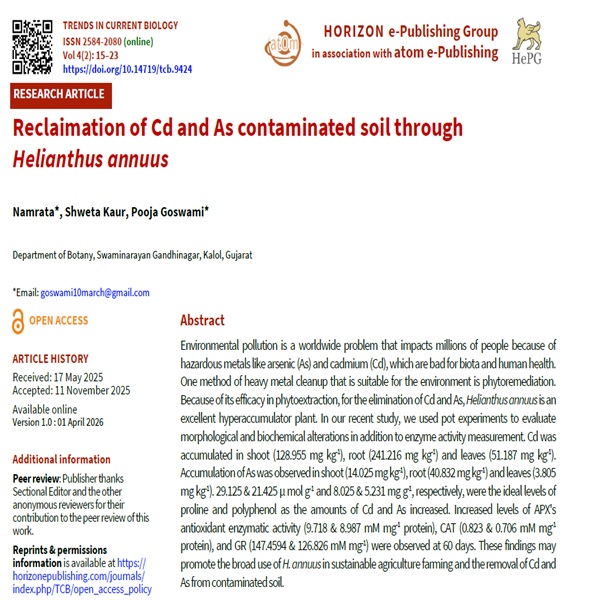
Environmental pollution is a worldwide problem that impacts millions of people because of hazardous metals like arsenic (As) and cadmium (Cd), which are bad for biota and human health. One method of heavy metal cleanup that is suitable for the environment is phytoremediation. Because of its efficacy in phytoextraction, for the elimination of Cd and As, Helianthus annuus is an excellent hyperaccumulator plant. In our recent study, we used pot experiments to evaluate morphological and biochemical alterations in addition to enzyme activity measurement. Cd was accumulated in shoot (128.955 mg kg-1), root (241.216 mg kg-1) and leaves (51.187 mg kg-1). Accumulation of As was observed in shoot (14.025 mg kg-1), root (40.832 mg kg-1) and leaves (3.805 mg kg-1). 29.125 & 21.425 µ mol g-1 and 8.025 & 5.231 mg g-1, respectively, were the ideal levels of proline and polyphenol as the amounts of Cd and As increased. Increased levels of APX's antioxidant enzymatic activity (9.718 & 8.987 mM mg-1 protein), CAT (0.823 & 0.706 mM mg-1 protein), and GR (147.4594 & 126.826 mM mg-1) were observed at 60 days. These findings may promote the broad use of H. annuus in sustainable agriculture farming and the removal of Cd and As from contaminated soil.
Downloads
References
Ozyigit II, Karahan F, Yalcin IE, Hocaoglu-Ozyigit A, Ilcim A. Heavy metals and trace elements detected in the leaves of medicinal plants collected in the southeast part of Turkey. Arab J Geosci. 2022;15:1-21.
Ozyigit II, Nallbani BG, Yalcin IE, Demir G, Plakiqi-Milaimi A. Enhancing environmental monitoring: utilizing plant and soil assays to track pollution in a Turkish organized industrial zone. Spectrosc Lett. 2023;56(8):452-71.
Shetty SS, Deepthi D, Harshitha S, Sonkusare S, Naik PB, Madhyastha H. Environmental pollutants and their effects on human health. Heliyon. 2023;9(9).
Genchi G, Lauria G, Catalano A, Carocci A, Sinicropi MS. Arsenic: a review on a great health issue worldwide. Appl Sci. 2022;12(12):6184.
Murcott S. Arsenic contamination in the world. London: IWA Publishing; 2012.
Angon PB, Islam MS, Das A, Anjum N, Poudel A, Suchi SA. Sources, effects and present perspectives of heavy metals contamination: Soil, plants and human food chain. Heliyon. 2024;10(7).
Gall JE, Boyd RS, Rajakaruna N. Transfer of heavy metals through terrestrial food webs: a review. Environ Monit Assess. 2015;187:1-21.
Kumar S, Prasad S, Yadav KK, Shrivastava M, Gupta N, Nagar S, Malav LC. Hazardous heavy metals contamination of vegetables and food chain: Role of sustainable remediation approaches—A review. Environ Res. 2019;179:108792.
Jain H. From pollution to progress: Groundbreaking advances in clean technology unveiled. Innov Green Dev. 2024;3(2):100143.
Khanam Z, Sultana FM, Mushtaq F. Environmental pollution control measures and strategies: an overview of recent developments. In: Geospatial analytics for environmental pollution modeling: analysis, control and management. 2023. p. 385-414.
Aparicio JD, Raimondo EE, Saez JM, Costa-Gutierrez SB, Álvarez A, Benimeli CS, Polti MA. The current approach to soil remediation: A review of physicochemical and biological technologies, and the potential of their strategic combination. J Environ Chem Eng. 2022;10(2):107141.
Sales da Silva IG, Gomes de Almeida FC, Padilha da Rocha e Silva NM, Casazza AA, Converti A, Asfora Sarubbo L. Soil bioremediation: Overview of technologies and trends. Energies. 2020;13(18):4664.
Nedjimi B. Phytoremediation: a sustainable environmental technology for heavy metals decontamination. SN Appl Sci. 2021;3(3):286.
Sharma JK, Kumar N, Singh NP, Santal AR. Phytoremediation technologies and their mechanism for removal of heavy metal from contaminated soil: An approach for a sustainable environment. Front Plant Sci. 2023;14:1076876.
Bhargava A, Carmona FF, Bhargava M, Srivastava S. Approaches for enhanced phytoextraction of heavy metals. J Environ Manage. 2012;105:103-20.
Adeoye AO, Adebayo IA, Afodun AM, Ajijolakewu KA. Benefits and limitations of phytoremediation: Heavy metal remediation review. In: Phytoremediation. Cambridge: Academic Press; 2022. p. 227-38.
Oh K, Li T, Cheng H, He X, Yonemochi S. Study on tolerance and accumulation potential of biofuel crops for phytoremediation of heavy metals. Int J Environ Sci Dev. 2013;4(2):152.
Rizwan M, Ali S, Rizvi H, Rinklebe J, Tsang DC, Meers E, Ishaque W. Phytomanagement of heavy metals in contaminated soils using sunflower: a review. Crit Rev Environ Sci Technol. 2016;46(18):1498-528.
Zehra A, Sahito ZA, Tong W, Tang L, Hamid Y, Khan MB, et al. Assessment of sunflower germplasm for phytoremediation of lead-polluted soil and production of seed oil and seed meal for human and animal consumption. J Environ Sci. 2020;87:24-38.
Arnon DI. Copper enzymes in isolated chloroplasts. Polyphenoloxidase in Beta vulgaris. Plant Physiol. 1949;24(1):1.
John R, Ahmad P, Gadgil K, Sharma S. Effect of cadmium and lead on growth, biochemical parameters and uptake in Lemna polyrrhiza L. Plant Soil Environ. 2008;6:262-71.
Bray HG, Thorpe W. Analysis of phenolic compounds of interest in metabolism. Methods Biochem Anal. 1954;27-52.
Nakano Y, Asada K. Hydrogen peroxide is scavenged by ascorbate-specific peroxidase in spinach chloroplasts. Plant Cell Physiol. 1981;22(5):867-80.
Aebi H. Catalase. In: Bergmeyer HU, editor. Methods in enzymatic analysis. New York: Academic Press; 1974. p. 673-7.
Ghisla S, Massey V. Mechanisms of flavoprotein-catalyzed reactions. Eur J Biochem. 1989;181(1):1-17.
Abbas G, Murtaza B, Bibi I, Shahid M, Niazi NK, Khan MI, et al. Arsenic uptake, toxicity, detoxification, and speciation in plants: physiological, biochemical, and molecular aspects. Int J Environ Res Public Health. 2018;15(1):59.
Ci D, Jiang D, Dai T, Jing Q, Cao W. Effects of cadmium on plant growth and physiological traits in contrast wheat recombinant inbred lines differing in cadmium tolerance. Chemosphere. 2009;77(11):1620-5.
Figlioli F, Sorrentino MC, Memoli V, Arena C, Maisto G, Giordano S, et al. Overall plant responses to Cd and Pb metal stress in maize: Growth pattern, ultrastructure, and photosynthetic activity. Environ Sci Pollut Res. 2019;26:1781-90.
Lentini M, De Lillo A, Paradisone V, Liberti D, Landi S, Esposito S. Early responses to cadmium exposure in barley plants: Effects on biometric and physiological parameters. Acta Physiol Plant. 2018;40:1-11.
Bravin MN, Travassac F, Le Floch M, Hinsinger P, Garnier JM. Oxygen input controls the spatial and temporal dynamics of arsenic at the surface of a flooded paddy soil and in the rhizosphere of lowland rice (Oryza sativa L.): a microcosm study. Plant Soil. 2008;312(1):207-18.
Moreno-Jiménez E, Esteban E, Carpena-Ruiz RO, Lobo MC, Peñalosa JM. Phytostabilisation with Mediterranean shrubs and liming improved soil quality in a pot experiment with a pyrite mine soil. J Hazard Mater. 2012;201:52-9.
Ahmad P, Sharma S, Srivastava SP. In vitro selection of NaHCO3 tolerant cultivars of Morus alba (Local and Sujanpuri) in response to morphological and biochemical parameters. Hortic Sci. 2007;34(3):114.
Benáková M, Ahmadi H, Du?aiová Z, Tylová E, Clemens S, T?ma J. Effects of Cd and Zn on physiological and anatomical properties of hydroponically grown Brassica napus plants. Environ Sci Pollut Res. 2017;24:20705-16.
Guo H, Hong C, Chen X, Xu Y, Liu Y, Jiang D, Zheng B. Different growth and physiological responses to cadmium of the three Miscanthus species. PLoS One. 2016;11(4):e0153475.
Zengin FK, Munzuroglu O. Effects of some heavy metals on content of chlorophyll, proline and some antioxidant chemicals in bean (Phaseolus vulgaris L.) seedlings. Acta Biol Cracov Ser Bot. 2005;47(2):157-65.
Zengin FK, Munzuroglu O. Toxic effects of cadmium (Cd++) on metabolism of sunflower (Helianthus annuus L.) seedlings. Acta Agric Scand B Soil Plant Sci. 2006;56(3):224-9.
Baunthiyal M, Sharma V. Response of three semi-arid plant species to fluoride; consequences for chlorophyll florescence. Int J Phytoremediation. 2014;16(4):397-414.
Barhoumi L, Oukarroum A, Taher LB, Smiri LS, Abdelmelek H, Dewez D. Effects of superparamagnetic iron oxide nanoparticles on photosynthesis and growth of the aquatic plant Lemna gibba. Arch Environ Contam Toxicol. 2015;68:510-20.
Rahneshan Z, Nasibi F, Moghadam AA. Effects of salinity stress on some growth, physiological, biochemical parameters and nutrients in two pistachio (Pistacia vera L.) rootstocks. J Plant Interact. 2018;13(1):73-82.
Goncharuk EA, Zagoskina NV. Heavy metals, their phytotoxicity, and the role of phenolic antioxidants in plant stress responses with focus on cadmium. Molecules. 2023;28(9):3921.
Tuladhar P, Sasidharan S, Saudagar P. Role of phenols and polyphenols in plant defense response to biotic and abiotic stresses. In: Biocontrol agents and secondary metabolites. Cambridge: Woodhead Publishing; 2021. p. 419-41.
Rudenko NN, Vetoshkina DV, Marenkova TV, Borisova-Mubarakshina MM. Antioxidants of non-enzymatic nature: their function in higher plant cells and the ways of boosting their biosynthesis. Antioxidants. 2023;12(11):2014.
Rajput VD, Harish, Singh RK, Verma KK, Sharma L, Quiroz-Figueroa FR, et al. Recent developments in enzymatic antioxidant defence mechanism in plants with special reference to abiotic stress. Biology (Basel). 2021;10(4):267.
Xie X, He Z, Chen N, Tang Z, Wang Q, Cai Y. The roles of environmental factors in regulation of oxidative stress in plant. Biomed Res Int. 2019;2019:9732325.
Maleki M, Ghorbanpour M, Kariman K. Physiological and antioxidative responses of medicinal plants exposed to heavy metals stress. Plant Gene. 2017;11:247-54.
Downloads
Published
Issue
Section
License
Copyright (c) 2026 Namrata Choudhary, Shweta Kaur, Pooja Goswami

This work is licensed under a Creative Commons Attribution 4.0 International License.